The high subdivision of matter in biological systems results in an abundance of interfaces that govern complex phenomena in ways we do not fully understand. Her work is aimed at developing new models of biological interfaces or biological-like interfaces (such as dye-sensitized devices) to control and exploit their unique properties. Combining morphological, structural, dynamic and electronic factors, her group derives new concepts and methodology to study these complex environments by bridging various time and length scales.
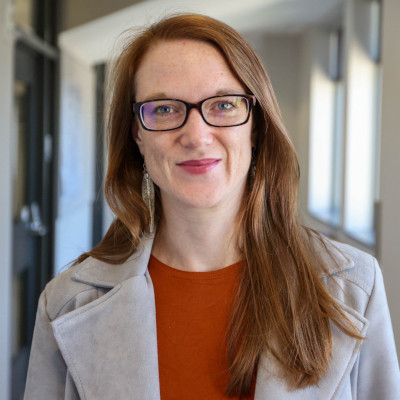
Valerie Welborn
Virginia Tech
Associate Professor of ChemistryTalk: "How Proteins Guide Ions: Electric Fields, Molecular Simulations, and Random Walks"
Ion channels are protein pores that control the movement of ions across cell membranes, making them essential for electrical signaling, muscle contraction, and many other biological processes. Although we can measure ion flow experimentally, it is much harder to see how individual atoms, water molecules, and protein motions work together to guide ions through a channel.
In this talk, I will introduce molecular electric fields as a way to describe the forces that ions experience inside a dynamic protein pore. Rather than moving through an empty tunnel, ions interact with charged residues, polar groups, water molecules, and the fluctuating channel environment. Molecular dynamics simulations of voltage-gated sodium channels show that these interactions create organized electric fields that influence ion transport. Electric-field analysis therefore provides a physical link between atomistic simulations and the biophysical mechanisms of ion channels. I will then discuss how the information from these electric fields can be incorporated into continuous-time random walk models, which describe ion motion as a series of jumps and waiting times through a changing channel environment. These models help connect molecular-level interactions to experimentally measurable transport properties. Together, these examples show how computational chemistry can translate molecular motion into biophysical insight.
vwelborn@vt.edu